Wednesday, October 15, 2008

Visit to Scott Base


Tuesday evening, the three medical members of the Air National Guard, our flight nurse and I were invited to Scott Base by Muppet, their paramedic. He will be leaving for New Zealand after a year on the ice so he wanted to have us over for a visit.

Our visit began by a brief wait at Derelict Junction for Muppet to arrive. He picked us up in a Toyota diesel 4 wheel drive SUV.

When we arrived at the base we could see the pressure ridges in the glacier. These form from the compression of glacial ice by movement of the glacier over time.
There are a couple of firefighters from Virginia here this season. One of them, Matt, has a mutual friend with my daughter. This is picture of Matt, nicknamed "Turtle", and me, taken in the hospital. A friend of Turtle's has a broken leg and will be medically evacuated. Turtle was here at the hospital visiting him.

On another note, I recently got the opportunity to go out to Pegasus Field and replace flags and runway markers. Pegasus is the only airfield of its type in the world. It is a glacier on top of which is compacted snow. There are plenty of compacted snow runways and roads, but this is the only one that is compacted upon a glacier. Upon this runway land C-17 jet transports, LC-130 Cargo transports and other large military cargo transport planes. The runway is 10,000' long and the airfield can support night vision goggle landings. It has modern navigational aids such as microwave landing assistance and other devices.

Saturday, October 11, 2008

Making Water

Antarctica is a land mass with huge amounts of ice upon it. In some places the ice is reported to be almost 3 miles thick. You would think that with all that frozen water, getting some to drink would be a simple matter of melting it. Not so fast. It takes huge amounts of energy to melt ice when it is minus 30 degrees F outside and the sun is absent 4 months a year.

All the water for McMurdo Station and Scott Base is produced in the McMurdo Water Plant. I had the opportunity to visit the plant. A sketch of the basic process is shown.


The basic idea is that there is a long pipe going from McMurdo base into the Ross Sea, the liquid part, deep underneath the frozen top of the sea. The sea water enters the plant at about 28 degrees F. If it isn't warmed, it will freeze the equipment. So, the cold sea water runs through heat exchangers (which recover heat from the diesel power generators).
The heat exchangers warm the incoming sea water from 28ºF to approximately 37ºF. The warmed sea water then is stored, indoors, in a huge steel tank. Sea water is very corrosive to steel. Therefore, this enormous tank has a plastic liner to keep the sea water from coming in contact with the steel tank walls. In this sea water there are all manner of tiny and microscopic organisms that must be filtered out before drinking water can be made.


The sea water is passed through a series of filters, each finer than the one before, to remove all microsopic organisms and debris. After filtration, the sea water is forced under very high pressure through the reverse osmosis tubes (shown at right). These RO tubes allow water to pass through a semi-permeable membrane while salts and other chemicals remain. The sea water is passed through this system two times to extract every possible ounce of pure water. There are two sets of these RO tubes. The second set of RO tubes, not pictured, are just to the right of the photo.


After all the pure water is extracted from sea water, the remaining brine is returned to the sea. The pure water is treated with carbon dioxide (CO2), calcium carbonate, and chlorine. These give the water desirable properties for drinking, protect the pipes, and prevent the growth of bacteria and other organisms in the drinking water. Water ready to drink is stored in huge steel tanks, indoors of course, and is pumped out to the McMurdo Station and Scott Base.

I mentioned earlier that excess heat from diesel power generators are used to warm incoming sea water. There is still more excess heat from those generators that is used to heat a recirculating glycol system that is used to heat some dorms (including mine) and buildings on station. Currently there are the old and new power plants. The glycol heat exchangers come from the new power plant which uses more efficient generators. The old power plant is scheduled to be replaced by the new one when the new plant gets all the generators installed and is fully operational.


There is a sophisticated computer-driven monitoring system for the power plant. It may look like a video game but it is monitoring the function and condition of the six generators that are our lifeline. The temperature, oil pressure, engine RPM, electrical generation and other parameters of each of the six generators are displayed for the operator to see. Tests on any specific generator can be conducted. Logs of electricity production requirements along with fuel consumption are kept.


I hope you have enjoyed this tour of McMurdo's power and water plants. I have just completed a tour of the wastewater treatment facility and it too is quite interesting. The biosolids are shipped off continent to a US landfill; the treated liquid is returned to the sea. In a way, we are a closed loop liquid system. We make purified water from the sea and return the treated water to the sea.

Tuesday, October 7, 2008

Just One Flight Gets In

It's been a week since our first Mainbody flight was supposed to arrive. We got Fight #1 in yesterday afternoon. That went well.

Flight #2 was due in this morning at 0600. This means that yesterday the passengers got up and checked out of their Christchurch hotel. They spent the day out and about in Chch. They probably reported to the CDC at 2200 for a 0100 departure this morning. Their plane departed and got all the way here (5 hours in the air). While the plane was en route, the weather here took a sudden turn for the worse with high winds and blowing snow. Visibility went down to around 100' and the ceiling dropped to about 500'. This is below the limits set for a landing. The plane turned around and went back to Chch. Those poor passengers.

There was supposed to be a second flight today carrying Flight #3 passengers, arriving around 2200 tonight. It was canceled due to our weather. Flight #2 will try again tomorrow, with a scheduled departure of 1000, arriving at 1500. There's no telling when we will get caught up with the flights.

Saturday, October 4, 2008

Photos With Me In Them

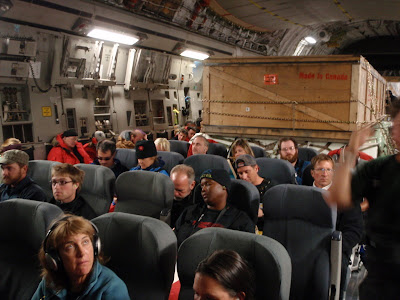
I've had requests for photos that show me in them. I've got a couple from a buddy who took them over the past month. This first picture is from the inside of the C-17 as we traveled from Christchurch, NZ to McMurdo Station, Antarctica. Can you find me?

From Medical Ice


My head is just under the lower left corner of the crate.

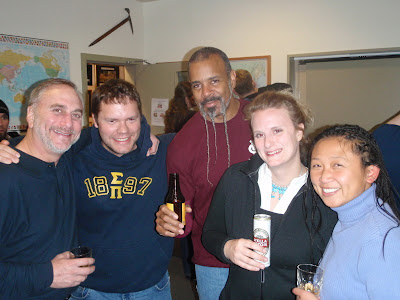
This next picture is of me with friends at Scott Base, the nearby Kiwi base. On some Thursday evenings they host "American Night" and we are invited over for a party.

From Medical Ice


Pictured from left to right: me, Jacob Woolery, Martin Robinson, Jess Ward and Mel Li.

I am not in this next picture, but since I recently wrote about Condition One, I thought I'd share a photo with you that shows the hospital in a Condition One. This picture is taken from about 40 feet away. If you look carefully, you can make out the red roof of the hospital.

From Medical Ice

Today's science lecture on penguins will likely be rescheduled because the scientist speaking is still in Christchurch. Now the hope is to try and bring a plane in on Monday, October 6. We will see.


Friday, October 3, 2008

Mainbody Delayed

Mainbody, the series of flights that bring the 700 -800 people to McMurdo for the summer season, was to begin flying last Tuesday. The flight that day was scrubbed for bad weather in Antarctica. The people in Christchurch had to either check back into their room, or if it was unavailable, had to find new lodging.

Wednesday, the next day, they boarded the plane and took off. After 3 hours in the air the weather at McMurdo turned bad and the plane had to "boomerang" or return back to Christchurch. The travelers had to find new lodging again. To compound matters, new people were arriving in Christchurch for Thursday's scheduled flight. Upon arrival, these new folks learned of the two busted days for group one. Group two realized they would never fly on Thursday.

On Thursday, the flight was canceled, again because of bad weather here at McMurdo. Group one and group two were now joined in Christchurch by group three. There are now around four hundred people in Christchurch waiting for the chance to fly down to the Ice.

Today, Friday, the plane was scheduled to take group one but the departure was scheduled five hours later than usual. As time approached for them to board the plane, it was canceled. This time it was canceled on the forecast of bad weather. Sadly, the bad weather never materialized and as luck would have it, group one could have departed and arrived without weather issues. Tomorrow, group four is scheduled to arrive in Christchurch. I'm sure hotel rooms are becoming scarce.

I'm wondering if Mrs. Shuwarger's fifth grade class remembers my earlier question: Who was the first explorer to reach the South Pole and when was it. For bonus points, tell me from what country this explorer came. You guys did a great job on questions about nacreous clouds, seals and penguins. Let's see if you can do as well with the question about the explorer. This is his picture:

Saturday, September 27, 2008

Condition One!

Saturday morning I awoke to a Condition One. Actually, I was awakened frequently during the night by howling winds and a gentle vibration of the building. The weather in Antarctica is categorized into three conditions.

  • Severe Weather Condition 1
    Issued when at least one of the following conditions is occurring or imminent:
    Sustained wind speed greater than 55 knots
    Wind chill temperature colder than -100°F (-73°C)
    Visibility less than 100 feet


  • Severe Weather Condition 2
    Issued when at least one of the following conditions is occurring or imminent:
    Sustained wind speed 48 knots to 55 knots
    Wind chill temperature -75°F (-60°C) to -100°F (-73°C)
    Visibility 1/4 mile to 100 feet


  • Severe Weather Condition 3
    Issued when all conditions exceed criteria for Condition 2. This is the normal condition.

If you are unfamiliar with knots as a speed indicator, I found out that a knot is equal to 1.15 miles per hour.


This YouTube video shows a Condition One here at McMurdo. It is was not made yesterday, but it is quite an accurate portrayal of the event.


When there is Condition One, everyone is required to remain indoors and not to go outside. I was, fortunately, in the hospital where we have the comforts of home: kitchenette, snacks, restroom, beds, computers, and TV. The Condition One lasted from about 7 am to noon and was more impressive than the hurricane I experienced in Houston back in the early 1980's. The snow here is as fine as baby powder, but when it hits you it feels like needles. Larger pieces of snow can feel like bullets. The wind will knock you over. I saw a recycling bin, a huge wooden box, blown down the street. A large piece of plywood took flight. Snow was blowing into the hospital's break room through a tiny crack above a window. Some buildings suffered minor damage or had windows blow out.


Last night the Carpenter's Shop, known locally as the "carp shop", hosted CarpStock - a party featuring about 4 or 5 rock bands, grilled hot dogs and hamburgers, lots of other munchies, and a variety of beverages. Everyone seemed to have a great time enjoying the music, dancing and letting out the stress of a busy week and lousy weather.


Tonight, at 8 pm, we will be treated to another Science Lecture. Tonight's subject will be on a variety of weather topics, such as Fata Morgana (Wikipedia Link) and other oddities. These are always interesting and topical presentations by leaders in their field.


Earlier today there was a craft fair. Local artisans showed a variety of amazing talents in photography, jewelry, knitting, and ceramics. I am continually impressed by the talent we have on station.


As some may know, I am Jewish. Jews celebrate Rosh Hashanah and Yom Kippur, our High Holy Days (HHDs), in the coming weeks. Celebrating them here, at McMurdo, is a bit of a challenge. We have a non-denominational Christian chapel (Chapel of the Snows) and arriving soon will be a military chaplain and a Catholic priest. However, there is no facility, liturgy, or accomodation for Jews to observe these holidays. My request to be permitted to view streaming audio or video of services from a (technologically progressive) Synagogue in the U.S. was denied. There is a strict policy against permitting streaming audio/video due to bandwidth limitations and it is the opinion of station management that any variance from this policy, regardless of how worthy, would lead to other worthy requests. The concern, as explained to me, is that to make an exception for one would require an exception to all, and there is no desire to have that happen. So, for me, observing the HHDs will require finding printed resources online and trying to conduct self-guided worship. This should be an interesting experience. I'll let you know how it goes.

Tuesday, September 23, 2008

The Hike

Last Saturday, the wind howled all night. When I got up Sunday morning it was still howling. I turned on the TV to our local weather report (just a series of slides, no audio). The temperature was -8 F with wind chill of -35 F. It is our "day off". The galley opened at 10 am for brunch. Afterwards, Shawn, a plumber, and I went for a hike. We went to Hut Point, which is where a cross sits on a hill, just past Scott's Hut. Scott's Hut was where he and his team arrived and built the shelter. The trip didn't end so well for them, as you probably know.

I got all decked out in my extreme cold weather gear for the hike. Let me tell you what was involved from the inside out:
underwear and socks
thermal long underwear, top and bottom
jeans and long-sleeved knit shirt
wind pants and Polartec fleece pull-over
balaclava (the grey ski mask covering my entire head except for a small opening around my eyes
Polartec fleece stocking cap
specially protective sunglasses
Thinsulate lined gloves
Thinsulate lined hiking boots
big red parka with fur-trimmed hood


The tiny patches of skin that show on the photo were really cold. When facing the wind, I had to turn my head to keep the wind from creating frostbite on the exposed skin.

The plaque that sits outside Scott's Hut is shown.
The last photo is of me standing at the cross at the top of Hut Point. The cross is in memory of a fellow whose last name is Vince. He died at or near that spot in 1902. He was part of Scott's team.
The hike to Hut Point was with the wind at my back. No worries. The hike back was with the wind to my face. Phew, that was tough: fighting the 35 kt winds and trying to guard against the effects of the cold wind against my exposed face. I should have worn the full-face goggles instead of sunglasses. Luckily, no harm came of it. As soon as I got back to the main building, Shawn and I made arrangements to meet in the dining room, where I was planning a warm cup of cocoa. As I was washing up to go to the dining room, my pager went off (yes, I carry a pager 24/7). The call was from the hospital, which was just across the street from the dining room. I walked over to find Colin and Maureen, the other doc and the nurse practitioner, already there. The three of us waited for the arrival of a hypothermia victim. He was on a longer windier hike. The day was bright and sunny and he was tricked by the appearance versus the conditions. Anyway, his buddies recognized his distress and called in the emergency. The Search and Rescue team was on it immediately. They brought him to the clinic. We were able to rewarm him appropriately and safely.

Harry Owens, the summer lead physician, arrives October 10. Also expected to arrive during the summer flights are a radiology technician, laboratory technician, physical therapist, flight nurse, and physician assistant. They are all seasoned veterans of this place, which leaves me as the sole newbie.
Dr. Harry Owens

I am volunteering in the library on Sunday afternoons. It's quiet, warm and humidified. Glorious! At 8 pm tonight is a Travelogue by one of the group. It should be an interesting talk. I am going to give a science lecture in late January on Dengue Fever. Many of the people redeploying will visit southeast asia. This is one of the areas in the world that is experiencing an epidemic of Dengue, so I thought it might benefit our community to learn about it prior to redeployment.

Today Colin x-rayed and casted a broken arm. Tomorrow begins my weekly series of meetings.

I am so impressed by the research that Mrs. Shuwarger's fifth grade class has been doing on nacreous clouds, Antarctic seals, and penguins. Way to go! Now, can you tell me which explorer was first to reach the South Pole and when?